
In this guide
If you run a service business that produces a tangible result - like a builder, landscaper, or kitchen installer - your past work is your most powerful sales tool.
But most trades businesses display their work completely wrong. They dump 50 unedited, blurry iPhone photos onto a "Gallery" page with no text, no context, and no explanation. This doesn't build trust; it just creates confusion.
Why raw photo galleries hurt your brand
When a high-value client lands on your website, they aren't just looking for pretty pictures. They are looking for proof that you can solve their specific problem.
If you only show them a photo of a finished deck, they have no idea what it took to get there. They don't know if the site was on a steep hill, if you had to manage difficult council consents, or if the client was thrilled with the result. Without this context, you're forcing the prospect to guess how good you actually are.
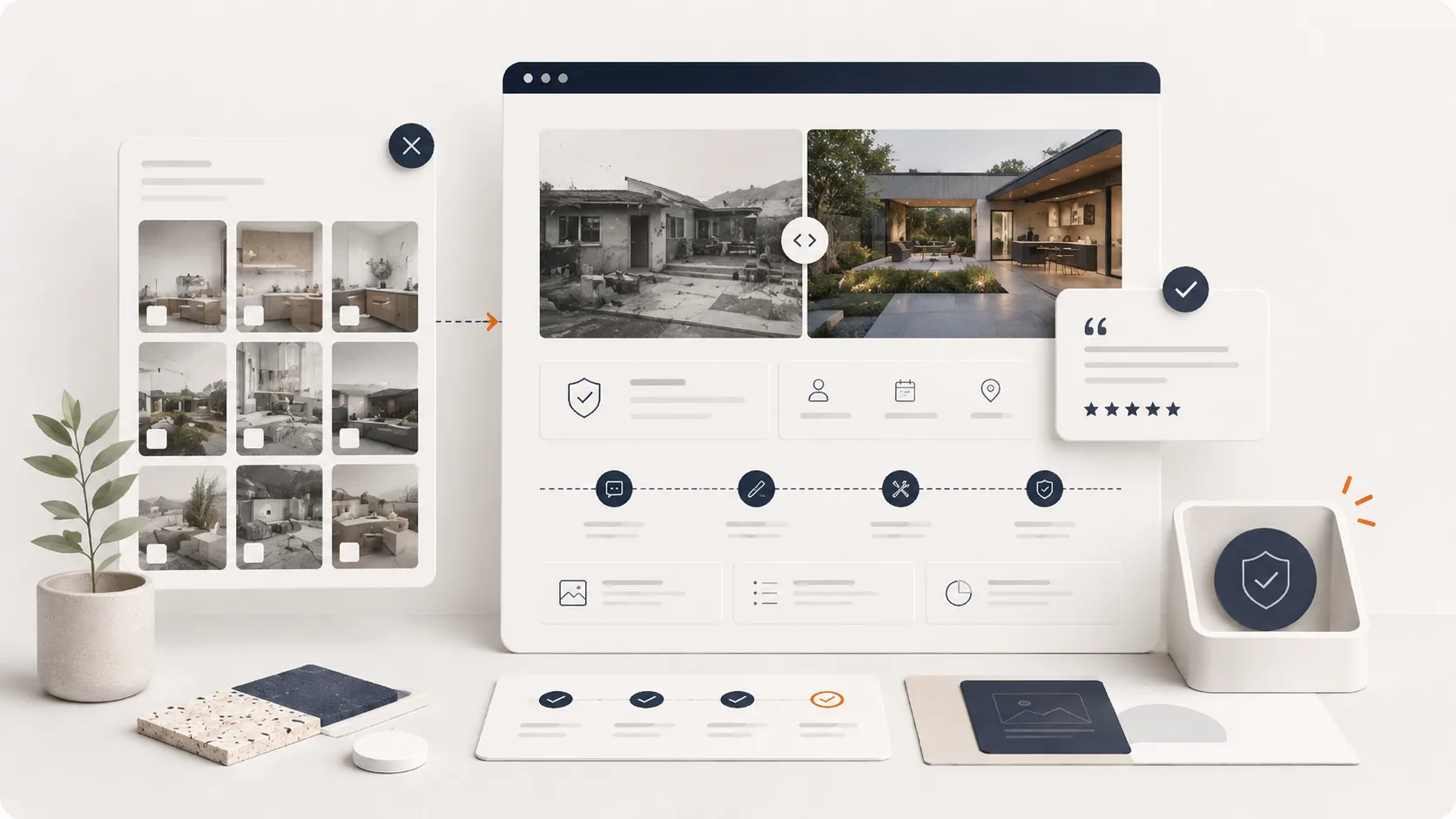
To win premium jobs, you need to stop using "Galleries" and start using "Case Studies".
Context is king: Selling the problem
A case study tells a story. The most important part of that story is the problem.
If you can clearly articulate the problem the client was facing before you arrived, your prospective clients will read it and think, "That's exactly what I'm dealing with right now." Once they realize you understand their problem, they will automatically trust your solution. (This is a core psychological principle we cover in our guide on what makes a website trustworthy).
The 4-part framework for high-converting case studies
Next time you finish a great project, don't just upload the photos. Write a 300-word case study using this exact structure:
1. The Challenge (What was wrong)
Explain the state of the site before you started and the specific pain points the client had.
Example: "The clients had a growing family, but their existing 1970s kitchen was cramped, dark, and disconnected from the living area. They loved entertaining but felt embarrassed by the dated space."
2. The Solution (What you did)
Detail exactly how your expertise solved the challenge. This is where you prove your technical competence.
Example: "We removed the non-load-bearing partition wall to create an open-plan flow. We installed custom engineered-stone benchtops, integrated appliances to save space, and added a large central island that serves as the new hub of the home."
Does your website showcase your expertise?
Get a free teardown. We'll review how you currently display your work and tell you exactly how to improve it to win better jobs.
Get a Free Teardown3. The Result (High-quality photos)
Now you show the photos. But instead of 20 random shots, curate it down to the best 4 to 6 images. Ensure they are well-lit, high-resolution, and perfectly capture the transformation.
4. The Social Proof (The client quote)
Never publish a case study without a quote from the client. The most persuasive thing you can say is nothing - it's letting your happy customers do the selling for you.
Example: "The team completely transformed how we use our home. They were on time, kept the site clean, and the final result is better than we imagined." - Sarah, Auckland.
How to take better job-site photos
You don't always need a professional photographer, but you do need to follow basic rules:
- Take true "Before" shots: Stand in the exact same spot for the "Before" photo and the "After" photo. This makes the transformation obvious.
- Clean up the site: Move the energy drink cans, sweep the floor, and put your tools away before taking the final photos.
- Turn on the lights: Open the blinds and turn on all the interior lights to make the space look as inviting as possible.
The final step: Link to a service page
At the end of your case study, don't leave a dead end. Add a clear Call to Action (CTA) linking back to the relevant service page, or asking them to contact you if they want a similar result. (For more on structuring these pages, read how to write a high-converting service page).

Keir Beaman
Lead Strategist
Keir specializes in helping New Zealand service businesses turn their websites from digital brochures into high-performing lead generation systems.
Want us to apply this to your website?
Get a free teardown. We'll personally review your current site and tell you exactly what needs to change to get more enquiries.
Get a Free Teardown